

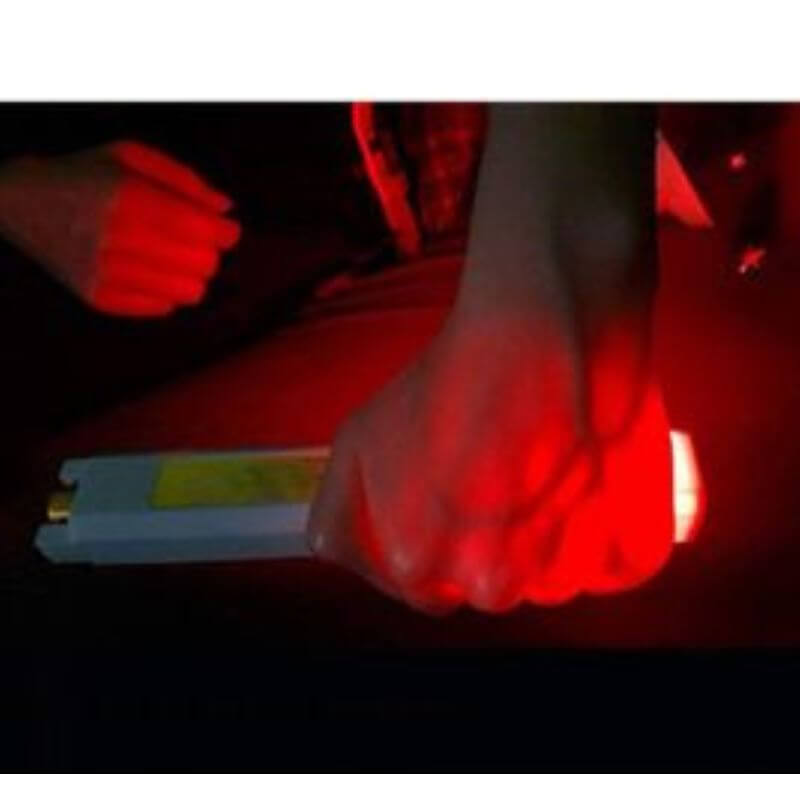
What is a vein finder?
A vein finder is precisely what the name implies: a device that helps healthcare professionals find veins quickly and efficiently when they need to draw blood or insert IVs.
Vein finders come in handy with patients who do not have easily visible veins. This is common with children and adults with obesity, older adults, and dark-skinned individuals.
Unlike the traditional way of finding veins, which is not always foolproof, the vein finder shows the veins to health professionals using infrared light, sound waves, or laser to locate veins beneath the skin’s surface.
This works because the infrared light is absorbed by the haemoglobin in the blood, which veins contain in higher amounts. Thus, the veins appear dark because they contain oxygenated blood, which absorbs more light. It is this absorbed light that the device detects, making the veins beneath the skin visible.
Typically, the procedure is carried out in a dark room, but with recent upgrades with different products, the method can be carried out anywhere, even on dark-skinned patients.
Types of vein finders
Vein finders are categorized into three different types:
Optical Vein Finders: Optical vein finders use light(infrared) to find the veins and are typically the cheapest due to their directness and availability.
Doppler Vein Finders: These use sound waves or ultrasound technology to find veins. The sound waves create an image of the veins on the screen, offering real-time imaging, especially for deeper veins. They are more expensive than the optical devices but typically more accurate.
Laser Vein Finders: These devices use a laser to highlight veins. As with any laser device, accuracy cannot be questioned. The con to devices like this is that they may be costly and less readily available than their counterparts.
Other features of vein finders to consider include:
There are different types of vein finders based on specifications and capabilities.
- Some vein finders are specific to the types of veins they can quickly locate.
- Vein finders that can scan only a particular area (for smaller areas and bigger ones).
- Vein finders that are more accurate than others; usually, this may be listed on the packaging.
- For size and weight, we have vein finders that are bigger and heavier than others and cannot be transferred around easily. You can go for a portable one if you need it to be mobile.
- Easy to understand – some devices are more complicated than others, and a vein finder is no different, so it is best to get one that you can appreciate seamlessly.
Price of vein finders in Nigeria
There are different types of vein finders, and the pricing of each one on Jumia can be found below:
- Vein finder for hospital and clinical use ranges between #45,000 – #80,000
- The infrared vein finder for clinical use #32,000
- The professional vein finder transilluminator for the pediatric unit costs between #14,000 to #17,000
- The portable vein finder. This vein finder is portable and suitable for emergency medical services. When writing this article, it was listed on Jumia for #70,000.
Regardless of the type you choose to buy, ensure it ticks all the relevant boxes above before committing to it.