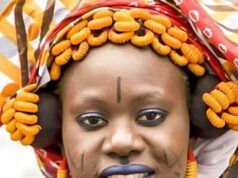


The Krobo people are an ethnic group in Ghana. They are grouped as part of the Ga-Adangbe ethnolinguistic group and the largest group of the seven Dangme ethnic groups of Southeastern Ghana.
The Krobo are farming people who occupy the Accra plains, Akuapem Mountains, and the Afram Basin. During the nineteenth century, they were one of the small states of the Gold Coast in the formative stages of political and cultural development.
Krobo Wedding and Customary Rites
Marriage is a vital and sacred institution in the life of the Krobos. In the Krobo custom, marriage is considered a duty, a requirement from the corporate Krobo society, and a rhythm of life in which all must participate.
Marriage is indeed a joyous and merry-making ceremony among the Krobo people. Therefore, though out all the stages, our traditional Klama songs and dance are performed. There is a lot of food to eat, jokes to share, and merry-making.
Se Pomi (Pre-Marital Investigation)
Se Pomi, also known as the pre-marital investigation, is the initial stage of marriage among the Krobos. In Krobo’s custom, before any marriage agreement between any couple, Se Pomi is first made by both families, especially the man’s family.
This ensures that the suitor does not have strange health problems or dubious characteristics. As an essential element in Krobo marriage, a lot of sayings are used to give meaning to Se Pomi:
- A hyɛɔ to nyɛ nane loko a heɔ e mi bi- One looks at the legs of the mother sheep before one buys the kid.
- A hyɛɔ tsoyi ba, loko a tsuaa e poku- One looks at the leaves of a tree before one digs its roots
- A hyɛɔ madaa nyɛ loko a jeɔ e he bi- One looks at the plantain tree before one digs the plantain suckers.
Tsutsumi lemi
Another stage of Se Pomi (Tsutsumi lemi) is getting acquainted with the mother-in-law. After the suitor’s family are satisfied with the pre-marital investigation, the suitor, in the company of the mother or an older woman, goes unofficially to inform the prospective mother-in-law to seek their daughter’s hand in marriage.
This unofficial rite is done so that the would-be mother-in-law will notify the husband of plans to have their daughter married. The amount paid upon visiting the mother of the woman is not fixed since it varies from lineage to lineage.
He Sijemi
He Sijemi, otherwise known as self-Introduction. The formal marriage rite begins with He sijemi. This ceremony brings together the families of the suitor and the prospective bride. At this gathering, official information is given out on the suitor’s part to the girl’s parents, expressing their desire to marry their daughter.
This rite customarily attracts two bottles of local gin. Before the acceptance of this drink, the man’s family must have already given out a drink (the previous night) for putting the girl’s family to sleep (Sihwɔmi da) and a drink for waking them up the morning of the marriage ceremony (Sitlemi Da).
Yobami
Bridal Permission, called “Yobami” in the Krobo language, marks the end of the preliminary official rites according to the Krobo tradition. Here, the suitor’s family official asks Permission from the girl’s family to have the girl given to them.
This enables the woman to move to the man’s house. This marks the legal beginning of the marriage rite, and the man can now exercise paternal control over the lady. For this, the man’s family is made to present two bottles of Schnapps.
The Yobami ceremony marks the end of the preliminary official rites and paves the way for the start of Yo he nitsumi (the principal marriage rites).
Yo He Nitsumi
The principal marriage rite starts with what is known as Agbo Simi (Knocking). It is believed that the man is still a stranger, and according to the Krobo custom, he needs to knock. This attracts two bottles of local gin.
The next stage after the ‘knocking’ is the man’s entrance into the house (‘Wemi Sɛmi’), attracting two bottles of local gin. With this stage over, the man customarily requests for the lady to be given to him finally. This request is known as ‘Yo Si Bimi.’
Yo Sɔlemi (Receiving the woman)
When the request is granted, the woman is given to the man. As tradition demands, the woman is made to sit beside the husband. This symbolizes the woman’s ritual transfer from the control and security of her original home to the husband’s family.
Hereafter, the woman becomes a full member of the husband’s family, and the husband has absolute control over her. The husband, after receiving the woman, thanks the family of the woman with either a bottle or two of local gi
Yo nya tsumi haami
Otherwise known as thanksgiving. In a show of appreciation, the new bridegroom makes some presentations in the form of items to the wife’s father and some specific people that matter most.
This serves as a positive witness of giving the woman in marriage. These items, known as Yo Nya tsumi haami, include; Piece of cloth (‘Ngatsɛ bo kpo’), a cutlass, native sandals (‘ablade’), an umbrella, and tobacco.
In addition, the Nganyɛ semi fɔmi (an agreed-upon amount) is paid to the mother-in-law. Other presentations: that must be made by the new husband include Money for the Brothers-in-law (Bajɔmɛ a sika), Money for the Family (Weku bi a sika), Drink to inform the chief (Matsɛ amaniɛ bɔmi da), etc.
Fia Peemi (The Marriage Blessing)
It is often said that the end crowns the work. ‘Fia Peemi” is the final rite performed during our Krobo customary marriage. It is done in the Paternal Home of the wife by two elderly firstborn women (‘Wemi Dedehi’). Items used for conducting this custom are an entire bottle of local gin, an amount of money that is divisible, and a leaf.
This particular rite is performed at the entrance of the Father-in-law’s room. Interestingly, both the bride and bridegroom are not allowed to have a look at this rite.
Before the start of the ceremony, the head of the bride’s family pours a libation with the local gin to gods, ancestors, and deities to invoke their blessings for the marriage.
The next step is breaking the leaf or the blade of grass. This ceremony is known as ‘Gba Yi pomi”. In this ‘Gba Yi pomi’ ceremony, the two women representatives pull the leaf until it tears into two parts. They exchange the broken leaf three times under their knees. While swapping the fractured leaf, the representative of the bride says:
“Fiaa, I jɔɔ nɔ ha mo” (I bless it for you), and the suitor’s representative responds by saying, “I sɔle” (I accept).
As a symbol of unity, the two representing families drink from the same glass in their sitting position and share the money equally amidst the singing and dancing of Klama songs.
Conclusion
A Krobo wedding is often expensive, with different stages of traditional practices. The Krobo marriage is an elaborate socio-cultural event that involves lots of singing, dancing, and chants.
The wedding also includes several rites and rituals that are practiced and religiously followed. Although Westernization has eroded some of this marriage cultural practice, most of these traditions are still among the Krobos.